- Background and Context
Climate change poses an existential threat to Africa’s sustainable development. Its impacts, ranging from increasingly frequent extreme weather events to shifting disease vectors and degraded ecosystems, are growing more complex and interconnected. Addressing these challenges requires innovative, interdisciplinary approaches that harness emerging technologies, including Artificial Intelligence(AI).
AI has become a critical tool in developing and implementing climate resilience strategies. It supports the creation of models, forecasts, and decision-making systems essential for understanding, predicting, and mitigating climate risks. By strengthening climate information systems and enhancing predictive capabilities, AI enables more effective resilience planning.
However, several challenges hinder AI’s potential in climate resilience, primarily:
- Limited training opportunities in AI-related Science, Technology, Engineering, and Mathematics (STEM) disciplines within Africa.
- Persistent gender disparities, with women significantly underrepresented in AI academia and the workforce.
Closing this capacity gap is crucial, particularly for early-career researchers and policymakers who shape climate action across Africa. Governments and stakeholders also struggle to adopt inclusive reporting frameworks for climate action. Strengthening AI expertise would enhance Africa’s ability to build resilience and support evidence-based climate reporting.
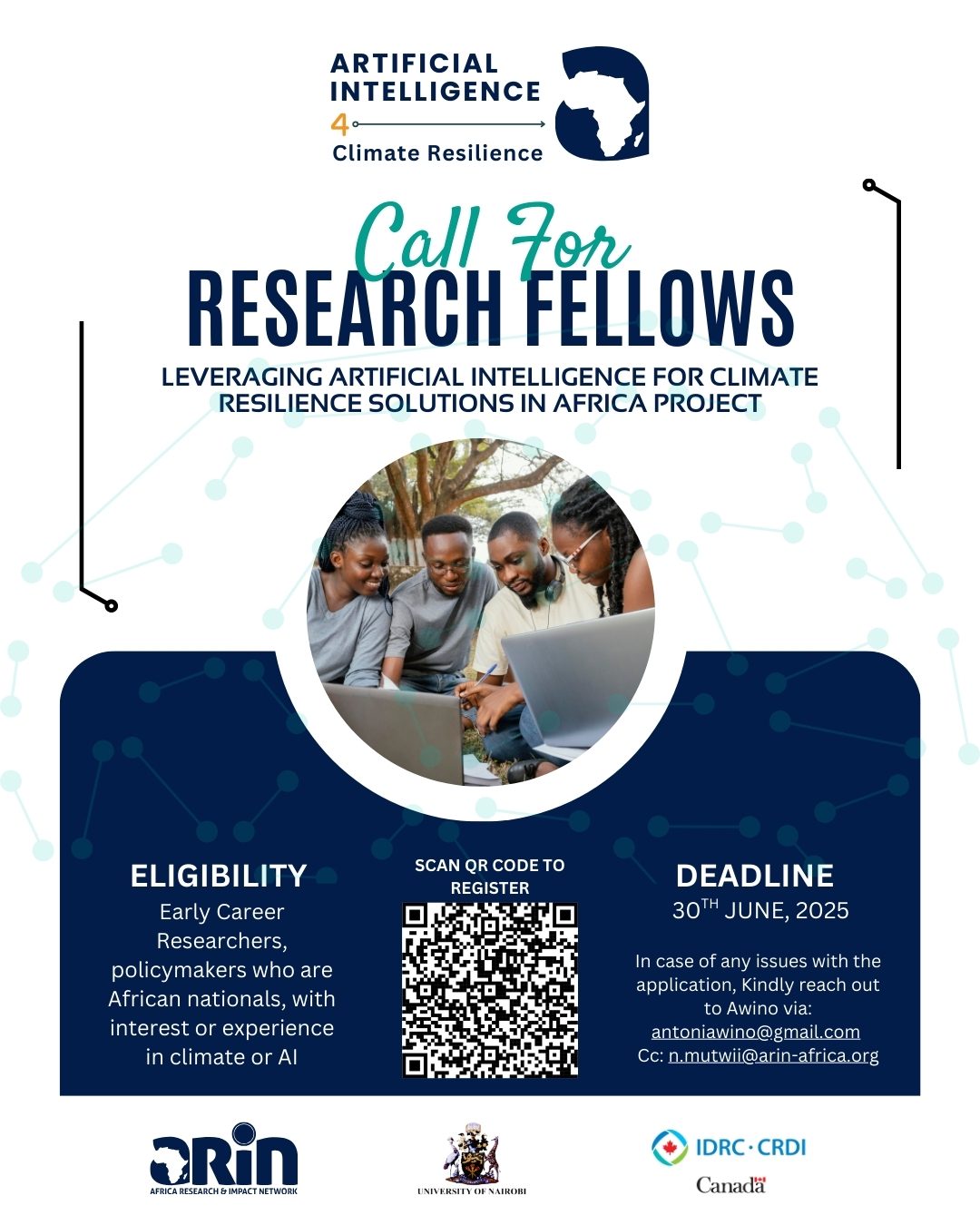
The Leveraging Artificial Intelligence (AI) for Climate Resilience Solutions in Africa project, spearheaded by the Africa Research and Impact Network (ARIN) in collaboration with the University of Nairobi and other ARUA centers and funded by the International Development Research Centre(IDRC),aims to explore AI’s role in fostering climate-resilient systems in Africa. The project seeks to:
- Build a strong AI foundation within academic and policy spaces.
- Institutionalize action-oriented capacity-building among early-career researchers and policymakers.
- Enhance women’s participation in AI-driven climate action.
- Engage stakeholders from academia, government, civil society, and the private sector toco-produce evidence, knowledge, and policy recommendations.
- Rationale for the Research Fellowship Program
To support capacity-building and research collaboration, the project is launching a Research Fellowship Program for early- to mid-career researchers, policymakers, and practitioners. This initiative aims to nurture a new generation of African scholars and innovators working at the intersection of AI and climate resilience.
Through the fellowship, selected individuals will conduct applied research or policy-oriented projects, actively participate in project activities, and contribute to knowledge co-creation. They will also strengthen South-South collaboration and interdisciplinary learning while amplifying African perspectives in global AI and climate discussions.
- Objectives of the Fellowship Program
The fellowship program seeks to:
- Deepen understanding of AI’s application in climate resilience across diverse African contexts. 2. Strengthen early-career researchers’ capacity to apply mathematical sciences and AI for climateaction.
- Build a network of African researchers and policymakers skilled in AI and climate resilience. 4. Foster institutional partnerships for AI-driven climate solutions.
- Produce case studies, policy briefs, and knowledge resources that inform policy and practice. 6. Provide a platform for research dissemination through ARIN, the University of Nairobi, and IDRC-supported forums.
- Fellowship Structure
- E-Learning Approach: Fellows will undergo a mandatory three-month e-learning program anchored at the University of Nairobi’s Institute for Climate Change and Adaptation (ICCA). The e-learning modules will cover AI fundamentals for climate resilience, allowing participants to tailor their focus areas. Fellows who complete the program will receive certificates and internship opportunities.
- Writing and Publishing Sessions: Fellows will participate in virtual workshops and seminarswithmentors from ARIN, the University of Nairobi, and Taylor & Francis to refine their researchcommunication, academic writing, and policy writing. Selected work will be published inreputablejournals through ARIN’s collaboration with Taylor & Francis.
- iii. Mentorship and Exchange Program: Over six to eight weeks, fellows will engage instructuredmentorship, connecting with researchers, policymakers, and sustainability leadersfromcollaborating institutions. This program integrates hands-on project execution withlearningexperiences, fostering sustainable partnerships within Africa and beyond.
- Monthly Webinars and Case study Simulations: . Interactive webinars and simulations will enablefellows to apply AI and climate policy knowledge to real-world scenarios, enhancing their problem-solving and decision-making skills.
- AI for Climate Resilience Academy: Top-performing fellows will be selected as AI for ClimateResilience Champions and awarded scholarships for an intensive two-week in-person training. Thisacademy will offer advanced modules, peer learning, and leadership development. Championswillalso receive tailored support to apply AI solutions to climate challenges across the Global South,while fostering communities of practice and policy influence.
- Small Grants and Case Studies on AI for Climate Resilience: AI Champions will be eligibleformini-grants to conduct innovative case studies in varied African settings. These fellows will haveopportunities to present their findings at global forums, such as Africa Climate Week andCOP30, and contribute to high-level climate science panels and pre-events. Results and best practicesfromthe studies will be compiled into a publication (book or special issue) to be launched at aflagshipevent.
- Thematic Areas
Fellows will be hosted within the ARIN network or partner institutions and supported toundertakeresearch or policy-oriented projects aligned with the following thematic areas:
- AI for early warning systems and disaster risk reduction
- AI in climate-smart agriculture and food systems
- Nature-based solutions and AI-enabled ecosystem monitoring iv. AI and urban resilience (e.g., heat islands, air quality)
- Governance and ethics of AI in climate decision-making
- Gender, youth, and inclusivity in AI-climate solutions
- Capacity needs and policy pathways for AI uptake in climate sectors
In addition to academic research, the fellowship will support policy-oriented projects that explore AI’s role in climate governance, planning, or service delivery, particularly in areas such as:
- Designing regulatory or ethical frameworks for AI in climate data management
- Piloting AI applications in national or subnational climate adaptation programs
- Integrating AI into national climate change strategies, policies, or monitoring systems
6. Eligibility Criteria
The fellowship is open to postgraduate students, researchers, and policymakers working in relevant fields. The first phase aims to recruit 100 fellows, who will undergo e-learning before a selected number advance to in-person training, small grant opportunities, and internships.
Eligible applicants must meet the following criteria:
- Hold a postgraduate qualification (Masters or PhD) or substantial experience inpolicyorprogram implementation related to climate change, environmental governance, or digitaltechnologies.
- Demonstrate a strong interest or mandate in shaping or applying AI solutions for climate resilience, particularly within African contexts.
- Exhibit Strong analytical, writing, and communication skills.
- Be affiliated with a recognized research, academic, governmental, or policy institution in Africa.
- Commit to contributing to interdisciplinary knowledge generation and policy dialogues. 7.Fellowship Duration and Support
Duration: 6–9 months
- Expected Outputs
Fellows are expected to produce:
- A research report or peer-reviewed publication.
- One policy brief or blog post summarizing findings.
- Participation in at least one regional workshop or knowledge dissemination forum.
- Application Process
Applicants are invited to submit the following documents:
- A letter of motivation explaining how their qualifications align with the fellowship.
- A 2-page concept note outlining their proposed research or policy project, relevance to the thematic areas, and expected contribution.
- CV (maximum 3 pages).
- A letter of support from a host institution or supervisor.
Kindly use the following application link to attach the above documents: https://docs.google.com/forms/d/e/1FAIpQLSeUtZX5Z279qtO1UUV_3D7ES- WW0qr2TGLoB4ZuUepdaZruTw/viewform