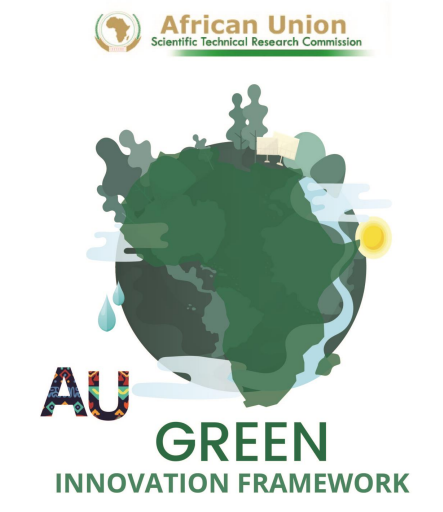
This report articulates an African Union Green Innovation Framework (AU-GIF) which is intended to guide African Union Member States towards a path of economic prosperity through sustainable technological, industrial and system innovations. The Framework aims to galvanise the efforts of and between African countries to enhance societal and economic resilience to environmental pressures, promote a greater efficient use of natural resources and achieve the aspirations of Agenda 2063 and the Sustainable Development Goals as envisioned by the United Nations.
In the face of an unprecedented degree of environmental pressure exemplified by climate change, an acceleration of biodiversity loss, land degradation, water shortage, and air pollution, the world is now increasingly looking to make a transition from traditional exploitative development models towards the green economy. A green economy is defined as one that achieves improved human well-being and social equity, while also significantly reducing environmental risks and ecological scarcities, and one which is low-carbon, resource-efficient and socially inclusive (UNEP 2011).
The green economy is imperative for Africa’s development, prosperity, resilience, and livelihood. Despite negligible contribution to the global stock of greenhouse gas emissions, Africa is the continent most vulnerable to climate change. At the same time, much of Africa’s economic growth remains resource intensive, relying excessively on the extraction of finite natural resources. Africa’s population is growing at a rate that will increase pressure on natural resource use and exacerbate poverty if no action is taken to address this trend. Moreover, the world is witnessing a transition to a global green economy evidenced, for example, by the growth of electric cars and renewable energy technologies. Global green growth transition presents opportunities for the African continent in terms of creation of green jobs, poverty reduction, supporting sustainable growth, restoring environmental health, and promoting climate and environmental resilience. Furthermore, the green economy offers a potential channel for delivering inclusive economic development in Africa while managing the social, economic, and environmental consequences associated with ‘business as usual’ approaches to development both in the continent and globally.
A transition to the green economy is almost impossible without innovation. Africa’s global competitiveness in the future decades depends very much on innovation in general and green innovation in particular. Innovation is a core requirement for improving Africa’s economic productivity while reducing its dependence on natural resource exploitation. Innovation is significantly important to create agricultural practices that are resilient to climate change and enhance African economies’ ability to add value to their natural resources. Green innovation is required for Africa to gain a global competitive advantage by harnessing its abundant renewable resources and aiming to become a net exporter of renewable energy and related energy technologies. In key sectors such as agriculture, transport, health, industry, and tourism, innovation in product and production, marketing and organisation processes is central to positioning Africa to effectively participate and benefit from the global greening, conservation, and sustainability….